Wednesday, May 23, 2012

False Claims and Vaporous Assertions


Unbending in his vehemence the Cuban master Micah Carpentier remains the unrivaled virtuoso of the Latin American avant-garde. People still talk about his hoarse,orphic voice and how it conveyed such authority and melody and grace.

So much of his work is the stuff of legend considering how after a brief embrace by Castro he was shunned and reviled by the official Communist commissars of art and culture. Some of his works were successfully smuggled out of the country, some were hidden or stored in remote corners of his beloved Havana and some were destroyed either inadvertently or out of malice.

For years I had heard rumors about a lost grand mural. People talked about a strange, cryptically encoded, autobiographical masterpiece. They spoke of a furiously painted carnival of lusty flesh, an ironic homage to early Etruscan erotica. Others spoke of an overtly seditious critique of totalitarianism and compared it to Guernica and Los Desastres de la Guerra.
 It appears that the lost mural has been found!
Los Amantes de la Partida Entre los Polos de Competencia del Deseo, Micah Carpentier, 1968

Recent renovations at the Palacio de Aldama uncovered a previously unknown wine cellar that still bares the inscription "Libaciones Almacenan Aquí Miguel de Aldama." Inside this crypt, rolled like a carpet and encrusted with mold, Micah Carpentier's lost masterwork Los Amantes de la Partida Entre los Polos de Competencia del Deseo was discovered. Three meters high and over five and a half meters long, the work was in desperate need of restoration. In a unique arrangement with the Península Ibérica Instituto de Conservación y el Revisionismo, the work left Cuba for eighteen months and was subjected to the most scrupulous and comprehensive process of repair and research.

I was among a privileged group of scholars and specialists who were invited to participate in this amazing endeavor.

David Schoffman at the Península Ibérica Instituto de Conservación y el Revisionismo, 2011

One piece of disturbing but not altogether surprising scholarship emerged from the study of the mural. It seems that Carpentier had at his disposal at least half a dozen assistants helping him complete the work. Among his team, two names stood out. One was Sidhartha De Corazon who today is considered one of Mexico's great political cartoonists and was instrumental in preparing the glassy oil gessoed surface that was critical for the painting's resilient pigmentation. The other was my good friend Currado Malaspina whose contribution to the work still remains vague.

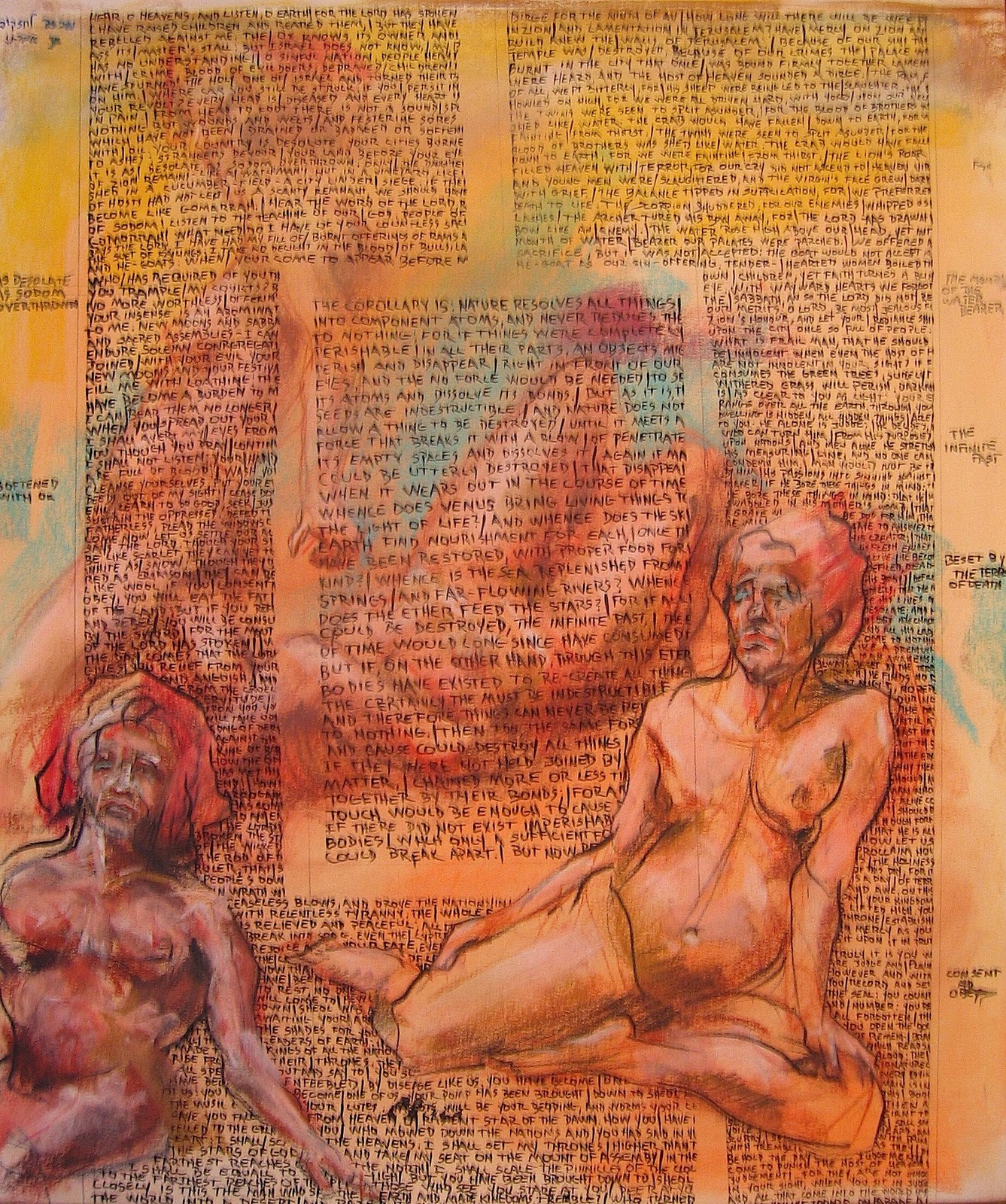
What has been made absolutely clear by this enterprise is that Malaspina's much heralded series Palimpsest, a work of unquestionable quality, is for all intents and purposes a direct, naked and shameless derivative of Carpentier's Los Amantes.

Palimpsest #3, Currado Malaspina 2011
 What a stinking disappointment!

Sunday, May 20, 2012

Désir


Currado Malaspina woke up on the morning of his 50th birthday with the terrifying realization that he had yet to win the Nobel Peace Prize. This was no idle daydream nor a further weakening of an already tenuous grasp on rationality. He had already won just about every significant prize the Republic of France bestows upon its artists, including the Grand'croix du Mérite, the Chevalier d'Ordre des Arts et des Lettres and the coveted Prix Laval for artistic collaboration. It only seemed just that he also win a Nobel and since there is no category specific to the visual arts he presumed that the Peace Prize was the only realistic option.

His scheme was as simple as it was absurd and the odd thing is, he almost pulled it off.


Malaspina never really took an active interest in politics - he is far too narcissistic - and despite the French fashion for detached anti-Zionism he never presumed to take sides in the Mideast. It is precisely for this reason that he hatched a plan to settle the conflict between the Arabs and the Jews once and for all.


He called it Désir - the first Palestinain/Israeli dating service!


With one office in Jericho and another in Ramat Aviv Malaspina's staff of twelve tireless love brokers tried to package and promote the idea of reconciliatory miscegenation. Never losing sight of his real goal, Currado hired the wily publicists of Heugot SMT to spread his quixotic gospel of peace through love.

He was prominently featured on Quattordici,  the popular French television news magazine that's a cross between TMZ and Sixty Minutes. He was interviewed in The Economist, The Times Literary Supplement and the International Herald Tribune. There were stories about Désir on Al Jazeera, CNN, CBC and the BBC. He was profiled in The Forward, Le Nouvel Observateur, The New York Times Magazine and the Huffington Post. For months, the Israeli press became obsessed with him eclipsing stories about both Iran and Eurovision.

His client list included Palestinian soccer star Ibrahim Koolatim-Utim, the West Bank writer and socialite Sooha Chazava and Niri Gas-Ruah, the star of Israel's top reality program Metachat Ha-Talit. But alas, fatwas and death threats proved far too incompatible with concupiscence. Wife swaps proved even harder than land swaps and religious taboos didn't mix well with aphrodisia. Currado's plan was short-lived.

Niri Gas-Ruah on her way to a "love-connection"
For now the Peace Prize is still on hold.

Thursday, May 3, 2012

SUDDEN EXPOSURE


The Ci'sponto Art Fair is part spectacle and part high-minded cultural subversion. Serious collectors make it a point to avoid this biennial event. Very serious collectors never miss it.

My good friend Currado Malaspina was stirred from his convalescence in order to curate the booth of his Swiss art dealer, Johann Gier. His approach was rather unique.

Just outside Ci'sponto is the small fishing village of San Viscere di Testa, an idyllic untamed paradise in the Cinque Terre. Aside from the occasional mudslide that typically tears several of the small travertine casolari off their foundations, life in San Viscere is as close to perfect as one can imagine. Malaspina descended upon this shangra-la with an unusual proposition.

He offered the local fishermen 500 euro to draw or paint a portrait of their wives - naked! (Silvio Berlusconi owns a villa in the neighboring Anobuco al Mare so the denizens of San Viscere are not easily scandalized). He received over four-hundred pictures and some were rather well done. 

Ritratto di mia moglie, Luana-Maria Pistoi, 2012 Benno Pistoi
 He installed these eccentric works salon style in Gier's 200 square meter space. 

The wives were not amused.

Tuesday, April 3, 2012

THE LACK OF ANXIETY OF INFLUENCE

 
Felicità Raggiunta #1, Currado Malaspina,  2009

The fine filament between appropriation and larceny is an irrelevant luxury residing uniquely within the quaint precincts of the ever dwindling class of what was formally known as "the serious." 

Nowadays, who really cares where artists find their precedents, their permissions and their aesthetic jurisdictions? What matters, plain and simple, is market value and in that department my old friend Currado Malaspina suffers no notable deficit.

However ...

Noted art historian Orestia Shestov is currently researching a new study on the roll of women in early 20th century European modernism. (Full disclosure: Ms. Shestov is a very close friend and colleague of mine.) Among her discoveries is the hitherto undocumented importance of the American expatriate artist, Faun Roberts.
Another Night in Clichy, oil on canvas, Faun Roberts, 1937 (Private collection)
 Roberts was born in Hackensack, New Jersey in 1898. After studying with Arther Wesley Dow and George Bridgman at the Art Students League in New York, Roberts sailed to Paris in 1921 and assimilated comfortably within the artistic community in Montparnasse. She briefly lived with the great Peruvian poet César Vallejo and it was through him that she became familiar with the artists and writers affiliated with the French Communist Party.

Her politics and her sexuality - her brief affair with Vallejo not withstanding, Roberts led an openly homosexual lifestyle - contributed, among other factors, to her subsequent omission from most narratives of the era. It is thanks to Shestov that soon that careless breach will be corrected.

Perhaps the big loser in all this will be the reputation of Currado. So much of Malaspina's work can be traced to Roberts. In fact, the more one sees of Roberts' work the more one realizes how overrated Currado Malaspina has been. In this light he seems practically void of any originality, ingenuity or invention whatsoever. 

I'm sure he'll find some way to deny this and I hear that he is already assembling an army of academic allies in order to discredit Shestov's methods and credentials. 

Look soon for an article in Artforum or Documenti di Calunnia by some hack ally of the 'eclectic' Mr. Malaspina. I have a feeling that the war of words is just beginning.

Monday, March 5, 2012

The Connoisseur Class


Among the noble allies of alchemy and accomplices of high art there lay in parasitical wait a coterie of unsavory swindlers. These poisonous peddlers of creative cozenage foul the rarified troposphere of our sublime culture. For every Lionel Trilling there's at least half a dozen Vissarion Belinskys and each Fairfield Porter comes with the value added tax of a boatload of Horace Ben Davenports. (Davenport, for those who have forgotten, was, together with Franck and Pissolle the three resident art critics for the 1940's French collaborationist periodical "Notre Culture Pur") 

One notable exception to this cruel principle of diminishing returns was the illustrious and now lamentably defunct Parisian monthly, Taide.


 Never before nor since has there been such a fine collection of scholars, critics, historians and artists working in such close collaboration toward the goal of discussing the world of ideas. The Partisan Review with its political infighting and petty rivalries pales in comparison to Taide. Bazin's macho band of bullies in Cahier du cinéma are a waxen shroud of recycled orthodoxies when stacked up against the intrepid intellectuals of Taide.


Between the magazine's inception in 1976 until its last issue in 2004, writers like Barney Aleksić, Gavriel Carrá, Nadya Bugaud-Tzvi, Loie Garaudy, just to name a few, were highly revered household names throughout the French speaking world. 

Soaring above the pact in both his intellectual range and in his grace as a human being was the late British philologist, Richard Ypres. Though he spoke and wrote in the most eloquently mellifluous French, when he published his work in Taide he always worked in close collaboration with his translator wife, Martine Poplout. 

When they visited Currado Malaspina's studio in the winter of 2003, they spent a full week researching, interviewing, reflecting, inquiring and speculating in order to compose a thorough rendering of his oeuvre and his place in the canon of 20th century modernism. 

Featured in the February 2003 issue, the sixteen page essay, "Suit d'un etat d'ivresse," (loosely, "Following a Bender") was a highly critical close reading of Malaspina's entire career. Beautifully written - Martine is also a well known writer of fiction, most notably the best seller "Théorie Rudimentaire" (Totou Presse 1999) -  "Suit d'un etat" quickly became a classic in its genre. 

Unlike his late friend Perec, Malaspina's disdain for critics is not an all consuming dismissal of the "leeching ancillary fringes of artistic invention."

As he wrote to me several years ago in a letter filled with uncharacteristic grace, "I salute and applaud our intrepid illuminators, our expert annotators, our pundits and expositors and I invite and encourage them to shed their lucent wisdom on my work."

Monday, February 20, 2012

TOO RACY FOR REHAB


In the dim light of the day-room my dear friend Currado Malaspina lies motionless on a weathered Louis IV canapé. The long lost elegance of the tattered divan echos the condition of the ailing artist. The deep creases of his still stunningly handsome face are a rugged topography of his strange and eventful life.


He will pull through but his convalescence will be long. 

Together with two Abyssinian petroglyphs and an 18th distemper on wood of St Michael, Currado brought back from a recent trip to Axum a eukaryotic parasite that has diminished him beyond recognition. He hasn't been able to work and is even too weak to read. Friends come and go bringing rare bottles of La Clarté de Haut-Brion and  DVD's of vintage episodes of Apostrophe.

His spirits were briefly lifted last week after a visit from Manon Olivier and Dahlia Danton. They sat by his bed, Manon softly stroking his hand while Dahlia read aloud from Barthes' classic Sade/Fourier/Loyola and Cendrars' Moravagine, two of Malaspina's favorites. 


He also loves Yona Wallach, especially Deux Jardins, but most people are too embarrassed to read it while Currado's elderly housekeeper and nurse are standing nearby.


Friday, February 3, 2012

MALASPINA INFOMERCIAL


My odd ailing friend Currado Malaspina frequently admonished me for what he discerned as a luxurious ambivalence to commerce (or in his words  "une ambivalence princière pour le bénéfice"). He claimed I had a patronizing disdain for the economic realities of the artworld and dismissively called me "uno fantasticatore" - a dreamer.

Perhaps.

And yet, in this last bit of self-promotion, I believe Currado Malaspina has gone a bit too far.

Wednesday, January 11, 2012

CHI ME L'HA FATTO FARE???


"How did I get myself roped into this?!"

The normally mellifluent voice of Eulalia Capillas was inflected with rage. She had just found out what everyone west of the Loire already knew. Currado Malaspina had published the Aquarelle Noirci - the fifteen notorious watercolors depicting what he calls "la béatitude de l'esclavage et la soumission."

L'Origine du Monde, Currado Malaspina 2003

As works of art, they are at best rather weak, but as a document of a louche look back at a more fervid, frenzied time in his life, these small pictures are nothing short of monumental. As most of my readers know, in the not too distant past my good friend Currado Malaspina collected mistresses and concubines with an avidity bordering on manic. To those who believe in a vengeful God, his current physical ailments and limitations would represent a fitting comeuppance. The Auquarelle Noirci seem to serve as a surrogate for a more corporeal fulfillment and as such deserve our indulgence if not our outright forgiveness.

Eulalia Capillas understandingly feels otherwise.

In the English language edition of this wonderfully designed folio (Salone Nuovo Press, Boston), Currado included half a dozen photographs that are both directly and indirectly connected to the drawings. 

I suppose the one below hit a nerve.


Eulalia étendu, Currado Malaspina, 2002


Tuesday, December 20, 2011

HUMANISM AND LARCENY


Lorenzo Valla, a thorough and intrepid researcher for L'Osservatore Romano has blown the lid off  Currado Malaspina's recent exhibition, Palimpsest. Although he viewed the show rather favorably, he noted that much of the work bore a striking resemblance to documents and manuscripts from the Biblioteca Medicea Laurenziana.

One example comes from what scholars call the "Thomas Moore Talmud."

Palimpsest #988, Currado Malaspina

Take a look above at Palimpsest # 988. Small script obscuring floating figures is a pictoral strategy used to great effect in Currado's work. Dating back to his famous early series "The Secret Growth of Doves," Malaspina has incorporated texts of dubious provenance in much of his works-on-paper. The introduction of conspicuously unobstructed nudes is something new that begins to appear in the Palimpsest pieces.


Valla's discovery is the previously unknown Tractate X. This incredibly beautiful 17th century fragment from the Thomas Moore Talmud is so similar to Malaspina in style as well as substance, it is hard not to conclude that he savagely appropriated a pre-existing image. Surely he hoped - unjustifiably it turns out - that no one would notice.


Grazie Lorenzo!!

Tractate X from the Thomas Moore Talmud, 1679

Thursday, December 15, 2011

EGO MICHI NON PLACEO


The Palimpsest series is a group of close to 1700 drawings that were produced between May 1996 and September 1997 when my friend Currado Malaspina was recovering from a near fatal diving accident.

The works which are all meticulously constructed through an intricate process of layering, burying, scraping, resurrecting, redrawing, revising, sublimating, surfacing, gouging and excavating are relatively weak when seen individually. After all, the work was grounded in a mindless though necessary process of physical and mental rehabilitation. They were more like heroic attempts by Currado to regain his ability to walk, feed himself, think cogently and go to the bathroom with dignity.

Palimpsest #1326, Currado Malaspina 1997
The drawings have recently been assembled - no small feat in light of the fact that they have been dispersed for over a decade among countless private collections and about a dozen museums. The credit goes to Francesco di Marco Datini, chief curator of drawing and prints at the Obscurum Phantasiae Nationali in Turin. He single-handedly secured the loans of over 1500 of the works and the impact of seeing all these images at once is truly staggering.

Currado was visibly moved at his opening. It was the first time I have seen him humbled, gracious and self-effacing. As we parted company I kissed him on both cheeks. He held me for a few extra uncomfortable seconds, long enough to whisper in my ear:

"I don't like myself."

Tuesday, December 6, 2011

Charisma? .... I don't see it ...

Aardashini Tasawwuf, the devastatingly beautiful actress and fashion model has been a permanent fixture at the Malaspina atelier for the past several months. How this withered, decrepit Frenchman  attracts such gorgeous women into his circle of admirers is beyond comprehension.

Aardashini Tasawwuf on the set of Leopards, Cricket and the Lost Ring of Tabir, 2011
She was with him at the opening of his most recent exhibition, Maquettes pour le Marquis at Gallerie Claude Pierre-Or on rue Galilée.

Aardashini Tasawwuf at the opening of Maquettes pour le Maquis, Paris

And he was with her in Kolkata where she was working on the forthcoming Tagore Production feature Leopards, Cricket and the Lost Ring of Tabir.

Aardashini Tasawwuf in her dressing room
 Malaspina was even able to cajole her agent into allowing her to appear in his latest video, which as a result, went viral on YouTube India.

You go figure ...

Wednesday, November 23, 2011

Forgotten French Painter


You don't want my brutal colleague Currado Malaspina to be your adversary. Know in advance that if you are a painter, he will never be your friend. The best you can hope for is to cultivate his ambivalence - but then again, that would mean  you are not even worthy of his enmity.

One notable exception was Francis X. Olivier.

Préparer à une Chirurgie, oil on canvas, Francis X. Olivier 1965

Currado absolutely loved Olivier. To Malaspina he was a mentor, a confidante, a protector and a father confessor. Malaspina was completely devoted to the older painter. Olivier had his share of detractors. Many considered him a half-baked, second generation abstract expressionist. Others called him an "américaine manqué." 

And those were were the ones who are considered charitable.

And yet, he was an extremely popular and successful French artist. At his death in 1989 his work could command at auction a healthy five figures. Now, a generation after his death, his paintings are worth upward of half a million dollars.

Bete Comme un Peintre, pastel on paper, Francis X. Olivier, 1978

Now for the news.

Currado Malaspina has been slowly selling his collection of Olivier's work, living quite well off of work he had acquired as gifts. This would not in itself be questionable had not Malaspina promise a dying Olivier to keep his collection intact and to ensure the well being of his heirs (wife, ex-wife, two mistresses, three legitimate children and two illegitimate children).

Legal? Yes
Ethical?

 ... this is the artworld ...


Friday, November 11, 2011

RIVALS WITHOUT RIOTS

Robust and consuming competition, the traditional trigger of artistic innovation is an abiding ethic with my avid compadre Currado Malaspina. "Depict the Vicar," the recent world-wide call to pencil and brush sponsored by UNNGO certainly brought out, if not the best at least the oddball in my dear, unpredictable friend Currado.

Currado Malaspina, "The State of Apostates" 2011

The parameters of the agon were quite simple: Depict an image of The Vicar of Yahweh using any type of media, in any format on any scale. The variety of work submitted to the UNNGO was truly astounding and speaks well of the international artistic community. The painter Jean-Paul Paulson from Brugge did a terrific oversized woodcut that may have been a bit too offensive for some of the judges. Dahlia Danton, currently living in India, incorporated images of Ganesh, Rajiv Montonaghanev and Rabindranath Tagore into a expertly executed Van Eyck like egg tempera painting. Not to be outdone, Shari-Lea Grossbard from Bethesda made a mural-sized quilt  based on the Mosaic and Wiccan traditions. 

The clear winner, though not without controversy, was Berlin's Manfred Fruchtwasser whose understated pastel on paper struck the jury as both lovely and appropriate.
UNNEGO "Depict the Vicar" judge Seymour Naqshbandi with Manfred Fruchtwasser's winning drawing.

Saturday, November 5, 2011

In Kitchen Cups Concupiscent Curds


The premature death of Roman philosopher Raimondi Modi was a bitter blow to my good friend Currado Malaspina. Known more for his unusual lifestyle than for his tuneless, sibylline prose, Modi felt much more at home sipping Campari and soda at Caffee Greco on Via del Condotti, then lecturing to his bored yet adoring students at La Pontificia Università.

Raimondi Modi, 2010
Raimondi's only significant contribution to contemporary European intellectual discourse can be found in the obscure Italian periodical La Scoreggia, in a piece he allegedly scribbled while waiting for a CT Scan at Salvator Mundi International Hospital. Titled Dialettica come un Raccolto in Contanti, (Translated alternately as "Dialectic as a Cash-Crop" The Basil Review XXVI no. 9, "Bonanza!" London Review, Spring 1995 and "A Question of Thyme"  Best Essays Anthology, Ontario University Press 2002),  Raimondi famously argued that impure idioms carry greater conviction and are more resolute when the shared responsibility of language loosens its empirical dominance. It was a revolutionary concept at the time and it remains vigorously debated to this day although its relevance has long been superseded by the recent findings of Laclos and Gremaine.

He and Currado were always allied in a petulant consanguinity - two rotten peas in a putrescent pod. Admired more than loved, tolerated more than appreciated and far more indulged than actually understood, Raimondi and Malaspina represent that dying breed of highbrowed cosmopolitan flaneurs that flooded the byways and bistros of southern Europe in the 1980's and 90's.

Raimondi Modi ... requiescat in pace ...


Thursday, October 27, 2011

HAGIOGRAPHY

The grand atelier of Currado Malaspina at 93 rue Clapeyron is, among other things, a shrine to Micah Carpentier.


Shortly after the great Cuban artist's death, Currado saw to it that Carpentier's assets remain fluid. The Cuban government made no secret of its intention to fossilize both Micah and his work, declaring his Avenida 20 de Mayo studio a national landmark and a public museum. This, of course, would have consigned what little Carpentier left behind to the spiders and cockroaches. Currado, in what remains  to date his one and only noble endeavor, lobbied UNESCO to intervene.

And so it is that Micah Carpentier's  eccentric furniture, his votive candles, his personal momentos and his beloved, ill-tuned piano all reside in the 8th Arrondissement.

What remains of his work, the paper bags - the Chinese take-out drawings, the 48 Stations of Ecstasy - are scattered throughout the world and it will be the thankless  task of some venerable future scholar to finally assemble this work into a coherent whole.

The definitive Micah Carpentier still dwells within a Latin shroud of mystery and I for one do not trust Currado Malaspina to guard and maintain this legacy.
Micah Carpentier at work. Havana 1971


Sunday, October 9, 2011

RIMBAUD'S TEARS


The brilliant concert pianist, Philippa Monte-Zahav, in addition to practically owning the twenty-four miniature masterpieces known as Chopin's Preludes (Telmas Records 1999) is an unapologetic exhibitionist. To put it bluntly, she loves to take off her clothes.

Brouillard D'Après-Midi, Currado Malaspina, 2011

She is the subject, and perhaps even the object, of Currado's latest series of works entitled Larme.

They met a few years back in Madrid at a dinner party hosted by the legendary saloon singer, Baku Epstein. They knew each other by reputation and were immediately struck by how many people they had in common. Malaspina was in town delivering a series of talks at the Prado on 7th century BC Etruscan Kantharos whose high curving vertical handles he once likened to "les seins du grand-mère." Monte-Zahav was there recording Satie's Sarabandes.

Currado claims he was drawn to the pianist because he found her so uncannily sexless. She remembers their early encounters rather differently but it was in Madrid where the germ of the Larme project originated.

It took a few years for the two of them to coordinate their heavily congested schedules but thanks to a grant from the French Ministry of Archived Scores and Texts (Bureau des Textes et Partitions Archivées) Currado Malaspina and Philippa Monte-Zahav were able to put all their projects on hold and complete this amazing collaboration.

"It's one thing to pay an art model," Malaspina explained to me recently over a plate of marinated olives at Allard on Saint-André-des-Arts, "it's quite another when an amateur so avidly insists on baring all without scruple. Sensuality becomes  clinical, mannered and theatrical and the frisson between artist and motif is altered beyond recognition."

I see his point. 

Saturday, September 17, 2011

PAPARAZZI


Ever since being awarded the prestigious Prix Mulet in 2009, Currado Malaspina has been badgered by paparazzi. Worn out by the pesterings and provocations of the dogged "entertainment press," he finally gave in and decided to ignore them. As a result, the French tabloids can be counted on to regularly publish scurrilous and compromising photographs of my beleaguered and indecorous friend.


On any given morning, an ill-focused photo will appear depicting the Continent's most beloved Lothario fixed in drowsy embrace with another vedette du cinéma, fashion model, socialite or innominate blanchisseuse. One gets the impression that Currado spends all his valuable time pursuing fleeting intimacies.


How can a grown man allow his polymorphously perverse, arrested sexual development be exposed in front of a callous and critical public and still maintain some modicum of self-respect? This is not some small matter of indiscretion or a harmless though antiquated expression of the French conceit of "droit de seigneur." No, Malaspina is a frail, emotionally impecunious adolescent.


I dare say, there are other ways to dwell in the public's imagination, pursue prominence and garner renown.

Thursday, September 8, 2011

IlIUM IS ABLAZE


Mime, considered by some as the stepchild to serious theater or the awkward actor's version of the bagatelle, has always been a guilty pleasure of my good friend Currado Malaspina. Mime troupes like The Oxford Ritualists, Omlette and Le Antilopi Fame, though indisputably coarse and uncultured, have traditionally maintained a loyal and devoted following among French artists and intellectuals.


The Oxford Ritualists, Dublin, 2006
The Oxford Ritualists, known mostly for their mute reenactments of musicals like Jesus Christ Superstar and Come Fly Away, have for years been fixtures at Malaspina's huge rue Gassendi atelier. Currado regularly hosts what he calls "cene di pantomima," lavish dinners where plates of exotic game are served to silent guests wearing togas and kothornoi. 


After much heavy drinking, improvisational mime games are played where quiet, passionate arguments sometimes devolve into bitter fistfights or worse.


By far, the most outrageous, if not the most talented ensemble is Le Antilopi Fame, comprised of the cousins Kaj and Ezra Antilopi and their Uncle Heikki. Canonized in their native Finland, Le Antilopi have performed at street fairs, arts festivals, opera houses, coffee shops, comedy clubs, art museums, amphitheaters, soccer stadiums and anywhere else where their unique social commentary can be effectively expressed.

They created a bit of a scandal this summer at the Kaajani Fringe Festival when they presented a moving yet comic rendering of The Trojan Women with sets and costumes by Los Angeles artist Dahlia Danton.

The performance was briefly interrupted by a small group of feminists and trade union activists who saw the piece as a mocking, ill-mannered apotheosis of housework.  Particularly galling was the scene where Talthybius, played by Kaj Antilopi, carried the body of the baby Astyanax on a dented TV tray while noisily munching on a bag of Bizli, a spicy snack food popular with Finnish and Scandinavian children.


The piece, hailed by most local critics, was written by Heikki who, like Currado, is always looking for a juicy succès de scandale.  Indeed, the two are cut from the same transgressive cloth.

Le Antilopi Fame, Kaajani Fringe Festival, September 2011 (left to right, Heikki Antilopi, Kaj Antilopi, Ezra Antilopi)


Sunday, August 14, 2011

Mauvaise Caractère


Alsatian painter, Seytal Reclus, is known less for his own work than for the profound influence he had over an entire generation of 20th century French artists. From his esteemed academic perch at L'Ecole Royale D'Art Decoratifs et de Dessin, Reclus can claim the likes of Carpentier, Goutauld, Goldmann and my dear friend Currado Malaspina as former students.

Seytal Reclus, Self-Portrait. 1933
A common trait found in practically all of Reclus' students is a cut-throat, ill-tempered, paranoiac competitiveness. Reclus used to tell anyone who would listen "tu aimeras ton voisin que si elle porte une jupe."

Another fractured biblical injunction frequently used by Reclus was "זכור את עמלק"

"Remember Amalek!"

To Reclus, "Amalek" meant anyone who at any time had ever done or said anything that even remotely interfered with your intentions.

The fact that Reclus' own paintings are eminently forgettable is evidenced by the self-portrait reproduced above. Even for a piece of juvenilia painted nearly a decade before World War II, it seems hopelessly derivative and unpromising. His later work, or what remains of it - his Paris studio was looted by the Nazis - showed little if any development or maturity.

Perhaps that explains his petulance - his sad fate as an avant-gardist manqué. Maybe his disappointment and despair fed an already fragile ego, turning someone who by nature was merely disagreeable into a complete and total asshole.

Whatever the case, his legacy lives on in my comrade and colleague, Currado Malaspina.

Thursday, July 7, 2011

TRUTH UNTOUCHED WITH MADNESS


Currado Malaspina's thoroughly idiosyncratic rendering of Oedipus Rex at the Austruche Theater was a disaster.


To call the production "unorthodox" would only invite an empty analysis of orthodoxy. So peculiar and disjunctive a work has not been seen in Paris since Utmaoux directed Phaedre at the Chochotte. With elaborately baroque sets designed by the Los Angeles based artist Dahlia Danton and inflatable rubber costumes engineered by Capote-Rhone SA the work is visually unfriendly though not altogether displeasing. Imagine Fragonard with helium balloons in a Vegas wedding chapel during a skirmish of Gog and Magog.


The problem lies in the fact that the Paris of Sarkozy is not the Paris of Alfred Jarry.  Next door to the Autruche Theater where Malaspina's work was staged is the fast-food restaurant Lolos, the Parisian equivalent to Hooter's. Directly across the street is the Disney owned Auchan hypermarket and down the block is a Trader Joe's. Malaspina's Oedipe Roi played to near empty houses while just a few blocks south at the Louie Braille Theater on rue Chapon, the musical EuroSpongeBob enjoyed nightly  sell-outs.


Il n'ya pas de justice.