Sunday, July 21, 2013

RANDOM NOTES


"The day artists begin to forgive each others' transgressions, when they lapse into amicable, mutual assent and grant each other easy amnesty will be the day the culture descends into its ultimate twitch of justifiable death."

My dear friend Currado Malaspina, embroiled in an insalubrious romance with a young woman half his age, is cavorting with his new companion this summer in over-priced spas and resorts throughout the State of California. I don't expect to see him but from time to time he drops me a note.

The aforementioned edict arrived the other day in an old fashioned manilla envelope and was part a larger, longer manifesto. I suppose he has time on his hands despite the hefty demands of his lovely callow concubine.

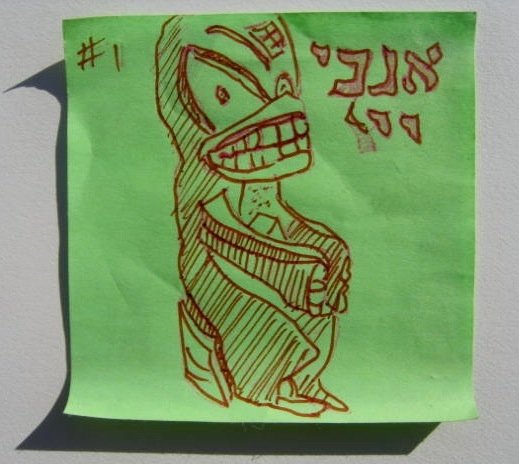
Included as well was this odd cartoon inartfully scrawled on a small sheet of hotel stationary.


Could any of these facts be somehow related?

Saturday, July 6, 2013

Le maître donne les devoirs aux élèves


My good friend Currado Malaspina recently attended his 40th high school reunion (yes, they indulge in such idiocies in France as well). He was struck, as many are in such circumstances, at how dramatically, or perhaps to be more precise, how suddenly people had aged. Seeing his former comrades from the lycée, it occurred to Currado that back then he never suspected that their much discussed future potential included such indignities as adulthood, much less impending old age. He distinctly remembers taking for granted the permanence of his physical bearing. Everything will remain the same, he remembers thinking, everything except one's oppressive tethering to one's parents

And it was there among his aging friends that mortality ceased being mere artifice, a device lending requisite yet illegitimate gravitas to a life, and started asserting itself instead as a real, inconvenient and terrifying fact.

Young Currado Malaspina 1973

In France, it could be said that the professional designation 'peintre' carries little of the bewildering stigma it bears here in the States. Currado was therefore greeted by his former comrades not with the rakish, wayward brow of condescension but rather with a bemused, almost bored nonchalance. In fact, the Lycée Mesrine class of 1973 boasted a few illustrious and unconventional citizens of the Republic. The flamboyant philosopher Simon Raphael Cohen and the jazz pianist Konrad Beauvence are just two names that come readily to mind. 

The assembly was addressed by class of '72, former Minister of Transportation and Export Louis-Philippe de Gorney, known mostly as a tireless champion of the Razor-Scooter, Vélib' bike-rentals and the 35-hour work week. He spoke mostly about what he called "the jagged intersection of charity and vengeance" and the significance of the Mesrine legacy. Currado wryly noted how fitting it was for the erstwhile government official to be looking for intersections.

They later met for coffee where they floated the idea of joining their talents and starting an NGO devoted to promoting the health benefits of walking.

The big surprise came when de Gorney reached into his vest pocket and pulled out a tattered, brittle piece of lined paper folded neatly in quarters. "Vous souvenez-vous cette"? he asked a stunned Currado. 

Indeed, Malaspina remembered it well.

from a high school notebook of Currado Malaspina circa 1971


Friday, June 28, 2013

EVERYTHING WHICH ARISES IS WORTHY OF PERISHING


 When he reached the age of fifty my good friend Currado Malaspina entered the swelling ranks of the nearly content. Unattained aspirations, unrequited fantasies and unrealized goals were suddenly foregrounded as his own background began to recede. He developed an unhealthy habit of counting in his head his former mistresses, lovers and wives. He began his daydreams with the phrase "what if" and revived old grudges with reveries of revenge. He became a man immersed in a past buried within an irretrievable web of circumstances and missed opportunities. 

To Currado the present became increasingly remote while he suddenly became effectively impotent.

Thus began the La Décennie Noire, Currado's dark decade of inactivity and depression.

Currado at the seaside sanatorium Sihirli Dağ, Izmir, Turkey 2005

Or so reads the conventional rendering of my good friend's mid-career creative impasse. The truth, as is typical in such cases, is much more nuanced. 

Rilke observed that "works of art are always the result of one's having been in danger," and so it was with Malaspina. Experiencing a profound decline in his formally robust libido, Currado began consulting with a battery of doctors, therapists, healers and hypnotists. Each one made the same sober evaluation. 

Currado was getting old.

Finding this unacceptable my resourceful friend found succor from a reliably familiar source - the brazenly naked, deliciously fluid, erotically charged commotion of human flesh in flux. With his ample resources Currado hired actresses and dancers, acrobats and hookers, weightlifters and bus drivers, women, men, young, old, anyone who would take their clothes off for him and pose.

The result was "Ten-Thousand Figures," a vast, Olympian act of voluptuary reclamation.

Detail from Dix-Mille Nus, 2001 - 2011, Currado Malaspina
   
The success of this enterprise is a matter of some dispute. Currado claims his legendary vigor returned within weeks. Others suggest that Malaspina became deeply disturbed at his burgeoning bisexuality. There are even a few skeptics who insist that the whole thing was one big public relations hoax.

One thing remains certain. As Currado enters his seventh decade, an age where one should find at least some small measure of sagacity and fulfillment, muddling insecurity remains the prevailing leitmotif for this overgrown adolescent genius.

Wednesday, June 19, 2013

LES CAHIERS DU PALIMPSESTE


I have heard from many quarters that Currado Malaspina's Palimpsest notebooks are based on a perversion.

To some people it's a perversion of faith, to others a perversion of fact but all of Currado's detractors agree that les Cahiers du Palimpseste are a corrupted, premeditated, ignominious sacrilege. 


 From sources both liturgical and cabalistic, my militantly laical colleague has turned the genuinely sacred into a soup of Daedalean banality. After mastering post-biblical Hebraic orthography (a skill not commonly shared among most Diasporic Jews let alone French Roman Catholics), Currado has filled dozens of notebooks with fragments as well as extended excerpts from the medieval verse of Ibn Gabirol, the Lurianic speculations of Hayyim Vital and Shalom Sharabi as well as the more contemporary metaphysical poetry of the Toronto based Itai Hoki-Kerach. 


The reaction has been fast and fierce.

The associate chief rabbi of Kehilat Iris in
Auvers-sur-Oise called on Currado to justify his seemingly arbitrary use of apocrypha and prayer. René Maigrichon, past president of the Conseil des Institution des Juives Croyants went so far as to publish an open letter of protest in the weekly news magazine Le Vieux Typographe.

Even the legendary Belgian pop idol Isaak Guitara whose latest release featured several controversially explicit Ladino love songs called Malaspina "unjustifiably provocative."


Ironically in Israel, the religious establishment remains fairly nonplussed. "If all this gets people to take a second look at the Maharal then what's the harm?" said Jerusalem seminarian Yossele Scharf whose view seems to represent the holy land's pious mainstream.

And I suppose, on the other hand, that if it gets the haredi (ultra-orthodox) community a little closer to Art Basel, documenta and the Venice Biennale,  well, that can't be a bad thing either.

Wednesday, June 5, 2013

HASTEN THE MERRY MAILMAN


It's always a treat receiving a letter from my dear friend Currado Malaspina. The epistolary tradition is a withering flame, a weak fragile rump from a faded past whose futile inefficiencies are ill suited to our hyper-utilitarian age. The illuminated missive is a rarer bird still and I credit Currado's stubborn persistence in maintaining this form of expression. For this alone I look forward to his every note.


His awkward drawings with their unembarrassed intimacies are nothing but refined, visual versions of the boastful bombasts one finds among contemporary rappers. Typically, his renderings depict some unlikely sexual conquest by some self-satisfied protagonist whose appetites range from the illicit to the bizarre. 


The letters themselves are usually full of rich gleeful anecdotes, bitter ruminations and detailed analyses of the French medical establishment as seen through the prism of his own unfortunate ailments. 

I recently received a long note written on what looked like the kind of paper placemat one finds in Greek diners in Jersey. The paper had that faint wavy tooth running evenly throughout - the kind of surface that vainly attempts to grant some small degree of gravitas to the cheeseburger, the iceberg lettuce/lone tomato salad and the bottomless cup of coffee. (I even think there was a small gravy stain blotting the corner, but that could have been watercolor). 


The letter contained a manifesto of sorts. It was a rambling exhortation defending the resurgent use of the Mesmer baquet in certain remote convents in Brittany. He claims that it has cured him of gout and that it alone restored his esophageal motility. (Perhaps the placemat had some talismanic significance). 

I believe my good friend has lost his mind which is very bad news for him but great news for us!

I love these strange new screeds.

Tuesday, May 14, 2013

ACCOUNTING


A wet glittering sun sizzles upon the gravel road that leads to Currado Malaspina's summer studio in Languedoc-Roussillon. Situated about three kilometers west of the huge salt-water swamp of Camargue, it is not unusual to spot one of the many beautiful cliff birds that are indigenous to the area.


The garden behind Currado Malaspina's Languedoc-Roussillon studio. 2013

For Currado, summer begins in April and ends sometime in late June when he cedes his little portion of paradise to foreign tourists, typically Germans, ready to spend upwards of €1500 a week for the privilege of renting his cozy two bedroom cottage.

Till then, he spends his time reading the Georgics, grilling gamey meats and painting small, insignificant watercolors on scraps of discarded drawing paper.

Untitled watercolor, Currado Malaspina, 2013
For my good friend Currado, the season is one glorious, languorous, unending day. His pictures, usually no larger than the size of a man's palm, command in the rancorous Parisian art market the decidedly immodest sum of €7500.

For my good friend Currado Malaspina, profit is never poisoned by the brunt of onerous exertion.
 

Thursday, May 2, 2013

THE SPARK THAT FORMALLY FLARED


 In 1998, my well-traveled friend Currado Malaspina was commissioned by Arvindah Rei to provide a comprehensive graphic guide to the Kama Sutra. Reading the text sutra by sutra, he was struck by its eerie familiarity. 

Though nominally a Catholic, Currado explained to Arvindah, that he suddenly realized he had "been a devout Hindu all these years."

"Dharma, Artha, Kama and Moksha are the four horses of my personal apocalypse," suggesting, I think, that these post-Vedic ideals were somewhat incongruent with his dissipated French, urban way of life.

 For the past 15 years Malaspina has been engaged in a pyrrhic struggle to assimilate East with West. All the while, he has been slowly and methodically reconfiguring his original vision of this seminal Sanskrit text. Pulling apart, creaking loose and tunneling through, Currado has eliminated his earlier innocence in favor of a patchwork of tortured ambiguity. 

What the unholy spirit has dispensed will be on view next month in a much anticipated, off-season exhibition in Paris's 6th arrondissement.


As a dark shadow lengthens over his earlier work and before the show opens, I think it is appropriate to remember that sweet and buoyant  radiance that characterized the younger version of Currado.

Arvindah Rei has since passed and the State of Tamil Nadu has turned his palatial home into a national museum. For ardent fans of Malaspina, a pilgrimage to Chennai is a must.


The work of Currado Malaspina permanently installed in the Arvindah Rei Museum, Chennai

Sunday, April 14, 2013

CONTRE LE FROID ENNUYEUX


Like many northern Europeans, my dear friend Currado Malaspina looks south for climatic relief during the long, bitter winter months. "Paris is the color of a faded tourniquet and I'm tired of the cold monotony," was how he put it to me in a recent email. This April has been especially cruel prompting my peripatetic colleague to flee to El Jadida on the north coast of Morocco where Orson Wells famously filmed his iconic film, Othello.

El Jadida Morocco


Like Wells, Currado fashions himself as something of an outlaw, an iconoclast and a dissident genius who stands aloof and alone beyond the pale of easy comprehension.

This might explain why he prefers to keep the paintings he holds most dear, closeted behind a veil of exaggerated secrecy. You see, when Currado is on vacation, (which is often) he loves to paint landscapes. Yes, Currado Giulo Malaspina, blasphemous shatterer of the sacred vessels of modernism has a hidden passion for the plein-air.

Almond Trees in Arles, Oil on paper, Currado Malaspina, 2009 (Collection of David Schoffman)


So while I wish him a productive and recuperative trip, I know that he is anxiously struggling to somehow emerge from within the shadows of Delacroix, Renoir, Matisse, Clore and all the other great artists who found inspiration on the North African coast.

Currado Malaspina, Mazagan Beach, Morocco, 2013

Wednesday, March 6, 2013

Palimpseste: The Creation Myth


It all started innocently enough when an ecclectic group of French artists and intellectuals gathered around a table the size of a small aircraft carrier. It was 1999 and the city of Paris was celebrating la fête de Pâques. The generous art patrons Alois and Brigitte Ormontagne were hosting their annual seder de Pessach for about 65 of their most intimate friends. Among the guests were Ludovic Halévy, Henri Blowitz, Alponse Halimi and his wife Ysmin, the Derridas, Zazie Modiano, Nathalie Artem, Solange Dreyfus-Meyer and my good, catholic friend Currado Malaspina.


Amid teeming platters of legumbres yenos de karne, arroz de sabato, berenjenas ahobadas, carpe à la juive (sometimes known as gefilte fish) and gallons of respectable Galilean wine, this pack of European intellectual luminaries held forth on subjects both sacred and profane. Currado was particularly taken by the participation of the children - the poet Anouk Atata's five year old daughter Chantalle recited the four questions without a flaw - and by the exegetical drama that was sustained throughout the interminable meal.

By the time they poured the ritual 16th glass of wine (Currado was under the mistaken impression that the ceremony demanded four cups but he was assured by his hosts that any multiple thereof was fine), most of the participants were pretty giddy and some were even advocating the Pharaoh's  position in the bible's most famous labor dispute.  

When former Algerian Foreign Minister Quentin Zhoof spilled half his 1984 Yatir Tishbi syrah over Alois' Haggadah, everyone took it as a signal to bring the festivities to a close. But Currado, (who by the way, does not drink), saw in this clumsy mishap a wonderful artistic opportunity. The wine-stained pages with their arcane typography and indecipherable alphabet struck him as an object of remarkable beauty. He insisted to his hosts that if he were allowed to take this brittle 19th century volume back to his studio he would delicately restore to its original state. This holy book had been brought to Paris from Bukovina by Ormontagne père in 1938 and was Alois' only link to a side of his family that perished during the War. He was nervous but grateful by Malaspina's thoughtful offer. 

Currado never did get around to returning the book and Ormontagne was too much of a gentleman to demand its repatriation. I heard that Malaspina cut it up and used its pages as drawing paper. Some even suggested that he sold it to a collector of rare books in New York who subsequently donated it to a religious library in Jerusalem.

Whatever the truth is, one thing is clear:

Palimpseste was born!

Palimpseste II no.4, Currado Malaspina, 2002

Palimpseste II no.3, Currado Malaspina, 2002
   

Monday, February 18, 2013

AN UNLIKELY ALLIANCE

  
Art critic Spark Boon and Currado Malaspina, Cannes, 2013

Sullen and desultory, my crisis stricken friend Currado Malaspina recently submitted to an extensive interview with the young New York curator and art critic, Spark Boon.

Boon, it seems, has made a name for himself as a repentant disciple of deconstructive intertextuality. His master's thesis at CalArts, Bakhtin, Barthes, Caselli and the new Dialogic Drawing was published by Stopped Clock Press with the much less ponderous title: Plagiarism: A Love Story. His position at the time was that the physical properties of paper inevitably linked all graphic material into one hypertextual ecosystem. As such, Michelangelo's drawings are the aesthetic equivalent to a driver's license, a child's notebook or a lottery ticket. It was a stirring piece of scholarship and it quickly earned Boon the reputation of a fulgent, up and coming public intellectual.

The story goes that Boon's Road to Damascus moment came when his girlfriend enrolled him in a life drawing class at the Art Students League in order to wean him off Ritalin. He was so taken by the prolonged patience he was able to achieve while drawing that he began to devote himself almost exclusively to his newfound draftsmanship. This in turn compelled him to reevaluate his whole perspective on the post-modernist canon, turning him into a sniveling apologist for the outdated notions of beauty, craft, form and quality.

Spark Boon, charcoal and pastel on paper, 2012
This in turn, brought him to Currado.

Spark Boon's sentimental recidivism and Currado Malaspina's pathetic 20th century modernist perspective are a perfect match. They recently spent many hours together in Cannes where Currado was recuperating from eye surgery. "His fawning attention is repellant," Currado wrote to me in a recent email, "but I hear he's a big-shot ('ayant une réputation non acquises') in Brooklyn, so I figured, why not?"

Why not!? I can think of about 200 reasons!

Tuesday, February 5, 2013

GUILTY OF POSSESSION


My bitter friend, Currado Malaspina sizzles with contempt at the mere mention of the word propriétaire. "Dante should have reserved a special place in his infernal fantasy for the landlords, bankers and the owners of Quick," he told me on more than one occasion. Currado has been renting his Place Paul Painlevé studio from the swindling slumlord Edvard Schchitonya for over twenty years and holds this elegent Russian émigré in delicious contempt.

Portrait of Edvard Schchitonya, watercolor and pastel on paper, Currado Malaspina, 2011

Currado once confided in me that to soothe himself into sleep he imagines poor Edvard in his ubiquitous soft yarn Norwegian turtleneck ski sweater writhing in a puddle of his own vomit screaming "au secours nom de dieu au secours!"

What riles Currado the most is that Schchitonya's avarice exceeds even the wretched, contemptible but somehow acceptable norm. His voracious cupidity surpasses even the tolerated levels of craven profiteering that we have grown so accustomed to in this Olympian age of greed. He seeks not only gain and surfeit but sincerely finds a perverse sense of accomplishment in the suffering of others. 

Case in point, Sandrine Pijnenburg, Currado's next-door neighbor.

Sandrine Pijnenburg, Paris 20013
  Known by everyone in the neighborhood as Sabtoosh (Sandrine's oddly appropriate diminutive of uncertain provenance), Pijnenburg has lived in the building since 1969 when it was still owned by the French-Algerian playwright Aggassi Hanasi. When Hanasi died the building was sold by his son Yehuda to a shill real estate development company called Rvota owned by the Russian oligarch Sergei Turgenev. Somehow, through machinations far too byzantine for Currado's math deficient mind to comprehend, in 1993 his landlord became Schchitonya.

Now, through the obscure Napoleonic "Droit de l'asile" a law that is invoked in France about as frequently as the law prohibiting women from wearing pants, Schchitonya is evicting his tenents in order to make the flats available as tax shelters for his Moscovite business partners.

Needless to say, Sabtoosh is none too pleased. According to Currado, Schchitonya has offered to buy out the 90 year grandmother for 20,000 euro, barely enough to afford a squalorous one-bedroom, rat infested tenement in some affronted suburb like Saint-Denis. She flatly refuses and is now embroiled in a bitter lawsuit that is eroding her life savings like an arctic glacier.

And why isn't Currado vulnerable to the rapacious Russian's appetite for profit? Why does he remain undisturbed in his bohemian atelier?

It's all in the family.

 Edvard Schchitonya is married to Malaspina's little sister Emelie. 

Emelie and Edvard Schichitonya on their honeymoon in St. Petersburg, 1998


Tuesday, January 8, 2013

CRITICAL CITADEL


Ever the puckish provocateur, my good friend Currado Malaspina has entered the cauldron of contentious Middle East politics. In the spirit of Honoré Daumier, he has recently published a series of uproariously scathing cartoons in the British satirical magazine The Toasty Baker.

Most of the drawings are unsuitable for reproduction - there is a generous sampling of dangling ankle spankers, wilted mamillae and detonated feculence - but the one that has gotten the most attention happens to be the most Orphic.


And the most priapic.

Saturday, December 8, 2012

AN OPEN (AND ILLUSTRATED) LETTER TO RELIGIOUS PEOPLE EVERYWHERE


My insane friend Currado Malaspina has taken on a new cause. In keeping with the French anti-clerical tradition he has taken it upon himself to militantly address the global religious community. 

"Ca me fait chier," is how he put it to me in a recent phone call. "I've had it ... aaa hijo puta de mierda capullo gilipollas imbecil ... I'm simply fed up!" (As some of you may already know, Currado can be fluently profane in about a dozen languages).

He recently published this open letter in the French weekly La Langue Inquiet. The clumsy translation is mine.


To whom it may so urgently concern,

Shut up! Faites taire! Siete zitto!

For once, try to be still and listen!

Had it ever occurred to you that you may be in error? (Who am I kidding? Of course not). Has it crossed your collective minds that maybe, just maybe, your understanding of the universe is to a certain degree flawed? Could it be conceivable that God has a somewhat different take on things than you do?


For instance, let's assume, just for fun, that there is a god (and by the way, how did such a half-baked notion such as monotheism gain such traction?) and that this god is all-knowing and all ... hell, I don't know ... all .... uhm ... merde!!! ... let's just say that he is really really nice and understanding, sort of like the math teacher you had in high school who wasn't married and who took a keen interest in you and made you feel special even though your other teachers thought you were a wise-ass. And this all-knowing, really really nice god watches over everything and loves everybody.

Tell me this, religious people: Why does he love some people more than others? Why does he play favorites and grants the French a 35 hour work week and a full month paid vacation each year but every so often he decides to flood the Ganges, the last time in 1998 where 1000 people were killed and over 30 million (yes, I said million!) were left homeless.

And what's up with all this gay bashing. Literally. As in "If a man also lie with mankind, as he lieth with a woman, both of them have committed an abomination: they shall surely be put to death; their blood shall be upon them." (Leviticus 20:13)


 Oh, and can I get an apology for the Crusades, yes, all of them, I - IX, but with special emphasis on Number Two which was particularly brutal on the Jews of my native France.


Listen up religious people, nothing good has ever originated with faith. 

The Ten Commandments you say?
 Really!? 

Like I need a document to tell me that killing is wrong? I think I figured that one out on my own. And how about the first, most famous commandment, "Do not have any gods before Me?" Hey god ... why so insecure? And #2, "Thou shalt not make any graven images?" As you know, I am Currado Malaspina, one of The Republic's most famous artists and for me Commandment number 2 is just plain BAD FOR BUSINESS!


And let's not even get into the Middle East, after all, if I say the wrong thing or for that matter even if I say the right thing but in the wrong way I may invite one of those lovely fatwas and frankly, I can't afford a bodyguard.


But while I'm in the neighborhood, explain to me how that wonderful epic poem known as the Old Testament doubles as a real estate document?  Its like replacing your GPS with a copy of Homer's Odyssey!


 And to my good friends across the ocean: de Tocqueville wouldn't recognize the place! The prideful ignorance of your religious right wing would be funny if not for its dire implications on the future health of our shared planet. How does a country which prides itself on its great colleges and universities produce political leaders with such contempt for science? Not since the days of Giordano Bruno has reason and empiricism been under such siege. I wish you luck, America.


I was standing beside a soft spoken and frail Henri Matisse when the art historian Jack Flam asked him if he believed in god. "Yes" he answered, "when I work ... I sense myself helped immensely by someone who makes me do things that surpass myself."

Some people, when they speak to god, go out into the world strapped in a suicide vest.

Others do this.


Best regards,

Currado Malaspina

Monday, November 12, 2012

LESBIA

Currado Malaspina"s work table, Rue Bernoulli studio, 2012

My aging friend Currado Malaspina is the perpetual student. Works left derelict for years are constantly being retrieved from moldy flat files and subjected to relentless reworkings, innovative re-imaginings and contemporary re-contextualization.

Revisiting the prior ports of personal embarkation is a dangerous game rife with regret, recrimination and cruel self-mocking melancholy. Currado, working within the silent womb of his Rue Bernoulli studio suffers none of these afflictions. To his great credit Malaspina sees the atelier as nothing but a provincial parish, a forgotten artery of urban artistic intercourse. In this way he can indulge in his work without the classic fatigue that his younger contemporaries suffer from with their self-imposed pressure to constantly provoke the "shock of the new." Currado has already picked the public's pocket and he did so without the neurotic dread that hampers so many emerging artists today.

He has recently discovered the work of American expatriate artist, Faun Roberts. In his words her volatile works from the 1920's and 30's are "a veritable dark Sabbath of frenzied, over-sexed witches (un sabbat noir, plein de sorcières frénétiques et lubriques), an absolute, untamed struggle with the angels and gargoyles of European history."

Appassionato, Oil on burlap, Faun Roberts, 1923
His encounter with Roberts has rubbed Currado's muzzle in ways I have never seen before. It's like he fell through a chimney and is now soiled with a new, uncomfortable disquiet. 

"Formerly I thought that my whole life was a swollen open sore of transgression and grievance," he told me over the phone not too long ago, "now I see that I was just another fondling of le père Sevin."*
And so my good friend Currado is once again turning inward. He is trying to perfect his knowledge of artistic anatomy and is studying sumi-e brush painting with the Korean master Kim Hong-do. Time will tell what his new passionate research will yield.
He is also struggling to translate Catullus' Clodia poems into contemporary French.
*Father Jacques Sevin is the founder of the French Scouting Association
 

Wednesday, October 31, 2012

LIBIDINAL INTENSITIES

Currado Malaspina, Paris, 2012

My old friend, the jarringly impetuous Parisian artist Currado Malaspina has an infernal temper. Like a drummer's brush, he skirts the surface of civility until neither prayer nor plea can prevent his rage from crashing violently down.

I remember one episode in particular where a capricious remark from a young critic made the long dead dance and the musty crypts quake from the crush of Currado's reaction.

Spark Boon, a recent survivor of the CalArts graduate program was in Paris on a research grant looking for meta-narratives in Lyotard's bank statements and laundry lists. Malaspina, as a young member of the Collège international de philosophie in the 1970's knew the great French theorist and Boon contacted him to ask a few questions. 

It should be noted that Lyotard and Malaspina shared a deep and abiding mutual distrust, but young Spark Boon had no way of knowing this in advance. When he innocently inquired about Currado's thoughts on Adorno's "negative dialectics" the fine timbers of reason collapsed and an untrimmed tirade exploded like Mauna Loa.

Spark Boon, Rome, 2012


I have to say that beneath the weight of Currado's wrath, young Spark Boon handled himself admirably. He is a promising scholar and a thoughtful and original critic. I am impressed by his character and his wit.

Though I am not too impressed with his French.
Dommage ...